ServicesWhole-Home Filtration
Whole-Home Filtration in Bastrop
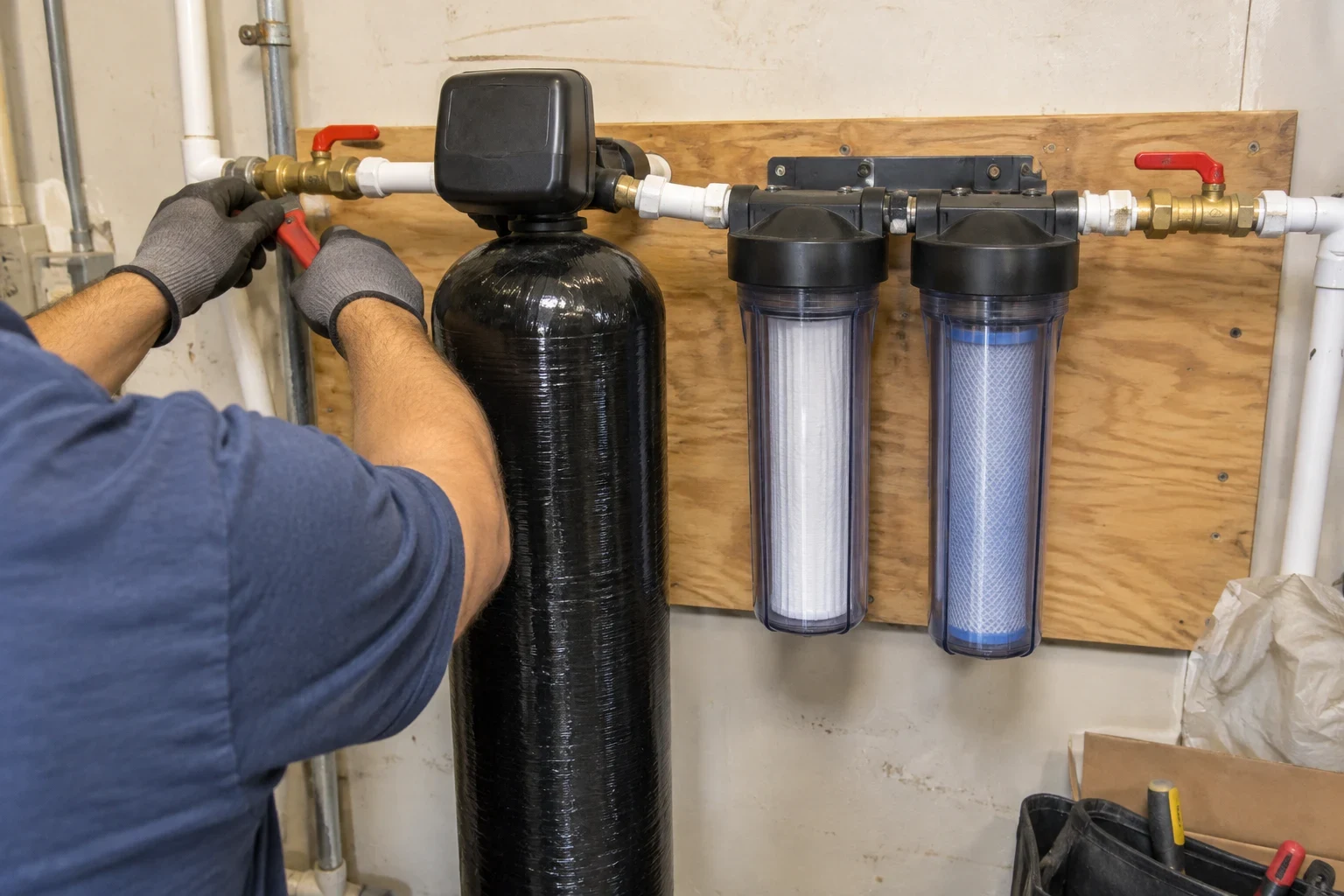
We mount a point-of-entry filter on your main line, so the water feeding your showers, sinks, washer and ice maker arrives with chlorine, odor and sediment knocked down. Each system is sized to your home's flow and fitted with shutoffs, a bypass loop and gauges that keep it serviceable for years.
What a whole-home system does, and when it fits
This system is installed at the point of entry, on the main line just past the meter and ahead of the water heater. A typical setup pairs a sediment prefilter with a tank or oversized housing full of activated carbon. Carbon pulls chlorine and chloramine out of the water by adsorption, and those two are what cause the swimming-pool odor in a hot shower and the dull taste in a glass. The prefilter traps sand and flakes of pipe scale so they never foul the carbon bed.
Choose it when the problem shows up at every tap in the house rather than one sink. If your goal is mostly better drinking water, an under-sink reverse osmosis system can be the smaller, cheaper fix. If you do not yet know what your water carries, water testing and analysis comes first so the media is picked for the actual problem.
Carbon will not soften water or strip out dissolved minerals. When scale is what you are fighting, we say so and walk through salt-free water conditioners or a softener instead.
What the installation includes
- Sized for your flow, not the box
- We tally bathrooms and fixtures, then check line size and incoming pressure. When a tank is too small, water rushes through the carbon, chlorine gets past it, and pressure sags with two showers running. We size for contact time so the media can do its job.
- Media chosen for your supply
- Ordinary granular carbon is effective against free chlorine. Chloramine is tougher, and catalytic carbon is what reliably breaks it down, at a higher media cost. Your test results and your supply's treatment method decide which one goes in.
- Shutoffs, bypass and unions
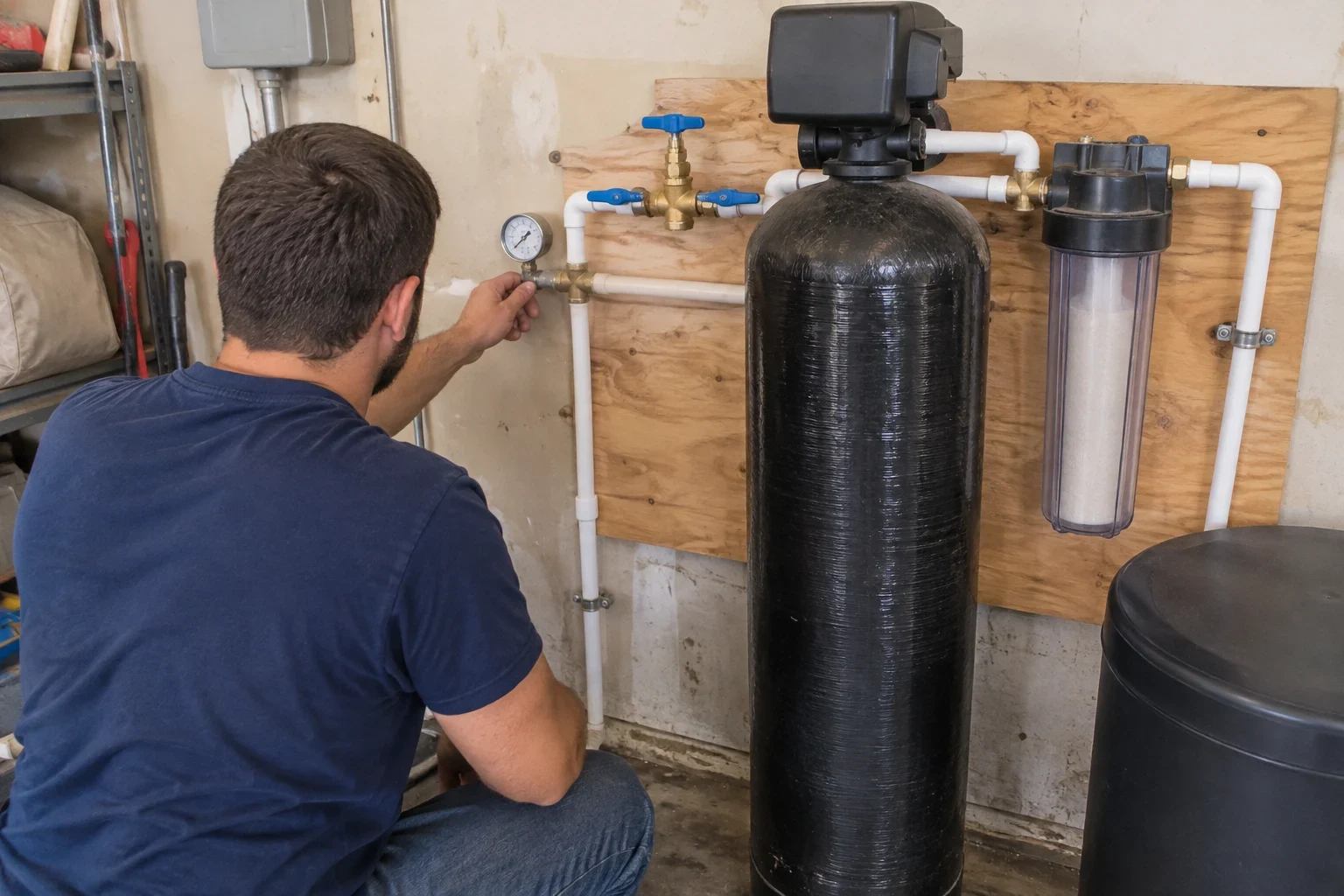
- We fit a valve on the inlet, a valve on the outlet and a bypass between them, connected with unions. The house keeps running water during service, and the system can be removed someday without cutting the line.
- Gauges before and after
- One pressure gauge goes upstream of the filter and one downstream. As the prefilter collects sediment, the readings drift apart, which tells you a cartridge change is due.
- Bonding jumper on copper
- A copper main line often carries part of your home's electrical ground. Splicing in a filter interrupts that path, so we add a jumper wire across the system to restore it.
- Free installation and cleanup
- Installation comes free as part of our offer. We lay down floor protection, take away cut pipe and boxes, and show you the bypass and cartridge change before we pack up.
Signs your home could use whole-home filtration
Chlorine odor while showering
Heat drives chlorine out of the water and into the steam, so a shut bathroom door traps the smell. Filtering at the main line removes it before the water ever reaches your heater.
Dry skin or brittle hair
Plenty of people feel a change once chlorine is out of their bath and shower water. It is often what pushes homeowners past a single faucet filter.
Grit in aerators and screens
Sand or small flakes in faucet aerators, a showerhead or the dishwasher screen mean sediment is moving through your line. A prefilter catches it before it wears down valves and cartridges.
A filter at every sink
Buying separate cartridges for the fridge, the kitchen faucet and a showerhead adds up. One system on the main line typically replaces all of them.
Coffee and ice taste off
Chlorine flavor shows up in ice cubes, coffee and iced tea. Treating water at the entry covers the refrigerator line as well as every sink.
What sets the price of your system
We quote after we understand two things: your home's plumbing and what is actually in your water. The quote is broken into lines, so the equipment, the filter media and the plumbing labor each show separately. Installation is free as part of our offer, so the lines you see are for parts and media.
Tank size and household flow
A home with three or four bathrooms needs a bigger tank or more media so water stays in contact with the carbon long enough. This is usually the largest factor in the total.
Which carbon goes in the tank
Plain granular carbon is the lower-cost media. Catalytic carbon, needed only when the supply is treated with chloramine, runs higher, and we specify it only when your water calls for it.
Getting to the main line
A main line exposed in a garage is a short job. A line hidden behind drywall, reached from a crawlspace or needing a reroute takes more fittings and more hours.
Extra treatment stages
Some homes need a second sediment stage, and some add a reverse osmosis unit at the kitchen sink. Any added stage appears as its own line so you can decide on it separately.
How the work goes on install day
- 1
A call and a free water test
It begins with a phone conversation about your plumbing and what you are noticing. We can arrange a free water test so your quote reflects your actual water instead of an assumption.
- 2
Choosing the spot
We look for the best section of main line, often in the garage or along an exterior wall. Systems mounted outside get a cover, because the Central Texas sun weakens plastic heads and housings over time. We also leave clearance for future cartridge swaps.
- 3
Cut-in and valve work
With the water off, we open the main line and install the shutoffs, bypass and unions. Connections match your existing pipe, copper, PEX or CPVC, and we use proper transition fittings anywhere two materials meet.
- 4
Rinse, test and handoff
Fresh carbon sheds fine black particles, so we rinse the bed out to a drain until nothing cloudy comes through. Then we pressurize and inspect each joint, note the gauge readings, and show you how to bypass the unit and change the prefilter.
Questions about whole-home filters
Will my shower pressure get weaker?
If the tank is sized right, the pressure loss is slight and most households never feel it. Noticeable drops usually come from a tank too small for the home or a sediment cartridge clogged with grit. We size by fixture count and install gauges on each side, so you can tell when the prefilter is to blame.
How often do the cartridges and carbon need replacing?
Most sediment prefilters are swapped every few months, depending on how much debris comes through your line. A tank's carbon bed lasts far longer, often several years, based on your water use and chlorine level. On install day we give you an expected schedule for your system.
Does it fix hard water?
No. Carbon removes chlorine, odor and taste, but calcium and magnesium pass right through it. If you see scale on faucets, showerheads or glass shower doors, we can test your hardness and go over salt-free water conditioners or water softener installation.
What happens with my water heater?
Typically nothing. The filter goes on the main line before the heater, so the heater simply fills with filtered water. We lay things out so the heater's shutoff and drain valve remain easy to get to.
Do I also need a drinking water filter?
Many homeowners find whole-home carbon does everything they hoped. If you want fewer dissolved solids, or extra protection against lead from older fixtures at the kitchen tap, a reverse osmosis system adds that. We will give you a straight answer on whether your water justifies it.
Find out what your water needs first
Call us and we will set up a free water test, then size a system for your home and plumbing. You get a clear quote before any pipe is cut.